Monday, September 04, 2017

Presentation of oblique non-ideal shocks at ORC 2017

222 - Non-ideal fish-tail shocks in ORC turbine cascades
by Davide Vimercati, Giulio Gori, Andrea Spinelli, Alberto Guardone 
Session 6C, Friday, at 10.30 

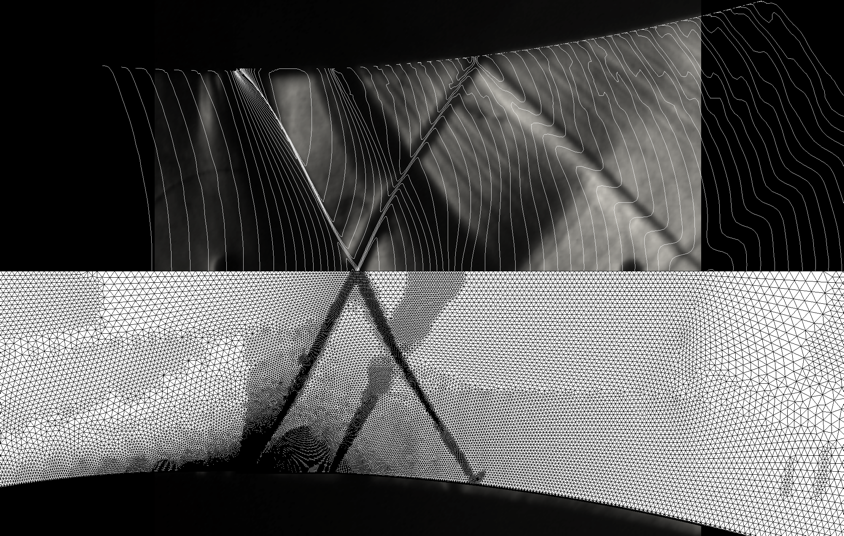
Abstract: Non-ideal shock waves at the trailing edge of supersonic high-pressure turbine vanes for ORC applications are studied numerically using the open-source SU2 solver coupled with mesh adaptation. Flow separation at the trailing edge of ORC turbine, where a supersonic Prandtl-Meyer expansion occurs, generates a limited region of separation between the supersonic flows on the pressure and suction sides of the blades. The merging of these two supersonic regions results in the formation of compression waves that eventually form a characteristic shock pattern comprising two oblique shock waves, called fish-tail shocks. The present investigation follow the study of Andrew Wheeler et al.~(NID 2016), where the authors focused on non-ideal compressible-fluid effects on the flow turning angle resulting from the Prandtl-Meyer expansion, which influences the shape and size of the downstream recirculating region. Here, the downstream process of coalescence into oblique shock waves is studied numerically to determine whether non-ideal shock waves can be observed in typical ORC operation. Non-ideal shock waves are possible only if the fundamental derivative of gasdynamics is less than unity and are characterised by the increase of the flow Mach number across the shock wave. The accuracy of the numerical tool is first assessed against a experimental results over a simplified backward-facing step geometry. Then, numerical simulations are carried out to determine the occurrence of non-ideal oblique shocks in conditions typical to ORC applications. Experimental results regard supersonic expanding flows of siloxane fluid MDM (Octamethyltrisiloxane, C8H24O2Si3) around a 90° corner. The Mach number is around 1.1 and the compressibility factor Z ~ 0.75.

Friday, September 01, 2017

Papers at ORC 2017

The CREA team will present five papers at ORC 2017, www.orc2017.com


  • 221 - Experimental observation of non-ideal expanding flows of Siloxane MDM vapor for ORC applications, Session 4C, Thursday at 14.20 
  • 222 - Non-ideal fish-tail shocks in ORC turbine cascades, Session 6C, Friday, at 10.30 
  • 223 - Experimental assessment of the open-source SU2 CFD suite for ORC applications, Session 3B, Wednesday at 16.30
  • 224 - Design and commissioning of a thermal stability test-rig for mixtures as working fluids for ORC applications, Poster session, Wednesday at 17.30 
  • 225 - An analysis of fast-response pressure probes dynamics for ORC power systems, Poster session, Wednesday at 17.30 

Monday, January 16, 2017

We are moving!!!

Take note: new address is Building B16A, Campus La Masa, Politecnico di Milano, Italy!!!


Thursday, December 15, 2016

Numerical simulations of NICFD flows with SU2 vs experiments!


First-ever assessment of a CFD code against experimental data for non-ideal compressible-fluid flows of interests for ORC applications is ongoing. Grid adaptation helps capturing shock waves.

Friday, October 28, 2016

Wonderful time at NICFD in Varenna


The 1st International Seminar on Non-Ideal Compressible-Fluid Dynamics was a great success! Thank you everyone for making this gathering so special.

Thursday, October 06, 2016

Join us at NICFD 2016!

Only two weeks to go before the 1st International Seminar on Non-Ideal Compressible-Fluid Dynamics for Propulsion & Power (NICFD 2016), the 20th and 21st of October, 2016, in Varenna, Como Lake, Italy

Seminar website: nicfd2016.polimi.it                    Contact: nicfd2016@polimi.it

Wednesday, September 14, 2016

Presentation at the 1st SU2 Developers meeting in Delft

Alberto Guardone gives an overview of NICFD capabilities of SU2 at the 1st SU2 Developers meeting in Delft, 5-6 of September 2016. In the slide, the latest TROVA results provide the first-ever validation of a CFD solver for non-ideal flows.


All presentations can be downloaded following the embedded links in the agenda http://su2.stanford.edu/documents/SU2_Dev_Meeting_Agenda_20160905.pdf